

I decided to take a holiday to Vietnam because my cousin was going at the same time. I didn’t think much of it, except that I’m going to go somewhere relaxing and warm. I’m of Vietnamese origin but being born and raised in California, my cultural identity was tied to being a proud American. As an Asian American growing up, there was a lot of effort spent in suppressing my Vietnamese heritage in order to fit in, like not speaking Vietnamese, eating simple lunches at school to avoid comments like “eww what’s that smell” from the other children. I actually took pride in saying “nope I’ve never been to Vietnam,” and when people say things like “you don’t look Vietnamese.” I would take offense when people call me Vietnamese, I’d correct them and say I’m an American. In a way I really didn’t know anything about Vietnam outside of my family’s occasional Têt gathering, eating Pho, and going to Little Saigon in Orange County for more food. I really didn’t know more than the average American about Vietnam. It’s a form of self-hate that I’m aware of now.
My father in law was the type of person who took a lot of pride in knowing about his origins, before I left he said it’ll be a great trip for me to discover where my parents came from. I decided maybe I’ll explore my parents hometown during my trip.
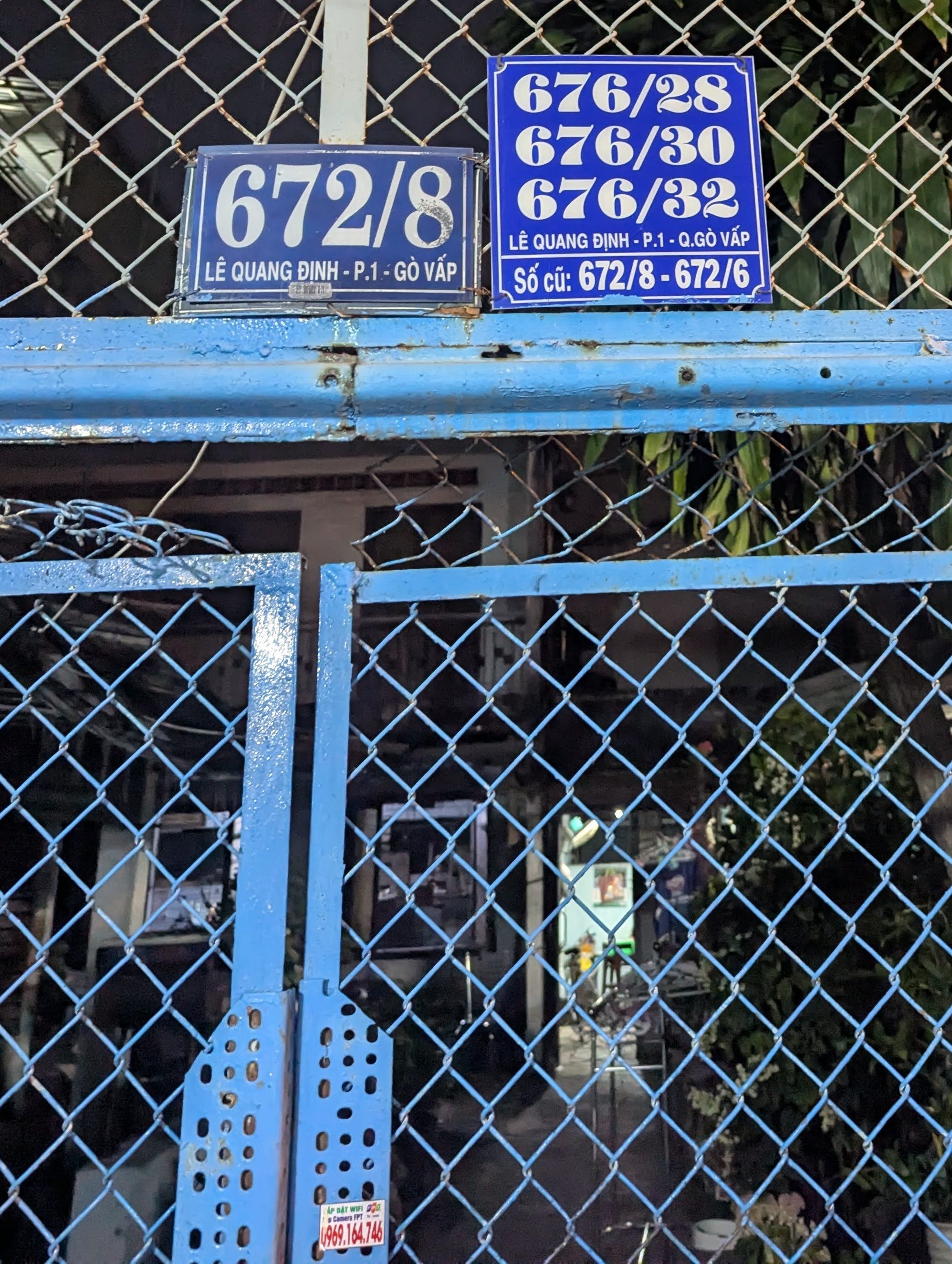
My mother was born in Saigon and I visited her old childhood home during this trip and we ran into her neighbor who she remembered from when she was 13 years old. My mother’s family was not originally from Saigon, they were originally from Hanoi, but my grandfather moved the family to Saigon in the 1950s because of a job opportunity as an interpreter with a French company. My grandfather was a doctor and spoke fluent French and Vietnamese.
To the rest of the world it was called the Vietnam war, but in Vietnam it was known as the American war. At the end of the American war, my grandfather was taken as a prisoner of war for aiding the enemy. He was thrown into the communist prison for 5 years, my mom was only 13 at that time, she didn’t see him again until the family reunited with him at a refugee camp in Malaysia when she was 17 years old. My grandfather was released from prison after my grandmother put in a lot of effort to get the right person to free him. He decided after being freed, it’ll be too risky to return to Vietnam, for fear of being oppressed for what he did, so he immediately fled to a refugee camp in Malaysia.
My grandfather was a doctor/interpreter for the French and US during the American war, the whole family would be branded as traitors to the country. After the fall of Saigon happened, under communist rule, my mother’s family might branded as traitors once they found out my grandfather’s actions of him fleeing the country after his release. Since my grandfather was in Malaysia, best if the family gets reunited there as well. My grandmother sold all her valuables to be able to bribe a small fisherman’s boat to taxi the family members out to the larger boat 2 or 3 at a time. The family was 8 people, meaning the fisherman had to go back and forth about 4 times to pick everyone up. My mom said she and her sister had to lay very still at the floor covered up in fishing nets to make it seem that they were just part of the cargo. My mom said they set sail to Malaysia at sundown, hoping no one saw them escaping in the dark. Their boat was afloat at sea for 3 days without food and water, near death. My mom recalled seeing something blurry off in the distance and informed her oldest brother, and it turned out to be a British ship going around the south China Sea to pick up the “boat people”. My mom’s family was rescued by Captain Barrie Bromby (I’m not even sure if that is real name, but that was all the information I had from his old emails and his Facebook). I met him when I was about 14 or 16 he was invited to the States, and my mom’s family showed him their lives that wouldn’t have happened if he wasn’t there to rescue them. After the rescue, he dropped them off in Malaysia. It was about 8 months of refugee processing by the western countries before my mom and her family was granted asylum to the United States to settle in Los Angeles California.
I’ve learned a lot about Vietnam during my travels, not just my mother’s origin story. The history of Vietnam was a bloody one, similar to the many wars in Europe, but in their case the wars were very recent, not hundreds of years ago. In the early history of the country, there were 3 kingdoms, the Cambodian kingdom in the south, the Cham kingdom in central, and the Viet kingdom in the North. The Chinese invaded often, reigned for about 400 years, then when the Chinese were kicked out the French came in and formed indo-chine for another 100 years. Then after the French war, the Japanese came in during WWII for about 4 years. Then the country split between north and south after WWII, into communism and the Republic. The French and United States came in to support the Republic, so that’s several more years of foreign occupation. The north was Vietnam, was led by a communist, Ho Chi Minh. After learning about him, I think he adopted communism to help reclaim the country from colonizers. He made some difficult decisions, so some of the Vietnamese in the county still have a lot of hate for him. I think did what he could to allow Vietnam to be independent from foreign invaders. Communism may be considered bad for other countries but worked for Vietnam. Like every country isn’t perfect, Vietnamese communism isn’t perfect either.

My perceptive now have been awakened after visiting Vietnam and learning about so much history. The Vietnamese are very nationalistic, matriarchal heritage, very accommodating and polite people. I feel proud of exhibiting these qualities and being Vietnamese. The Vietnamese-American experience is in its own subculture of Asian American, that cannot be found in Vietnam but only in America, and that’s where I derive most of my heritage from. It is a complex view that I can see now. My parents were people who fled the country because of the communism took over, and oppressed them during the war. South Vietnam was also very impoverished in the 1980s. They came to America, thinking its way better, richer, and a place where the communism would not oppress them. Of course they hated Vietnam, and taught me to be American first. USA was a country that welcomed them and treated them better than their country of origin. Vietnam today has come so far as since the 1980s, and bringing my mom back to Vietnam after 50 years had shed so much light on why she’s negative towards the country, but I think it’s granted her a new perspective now. I learned so much about her family during this trip and was conveyed in this post. I think my next visit to Vietnam, will reveal new things about my father’s family and perhaps more about my mothers family.
 Darkaqua Chronicles